Glycemic-Aware and Architecture-Agnostic Training Framework for Blood Glucose Forecasting in Type 1 Diabetes
Abstract
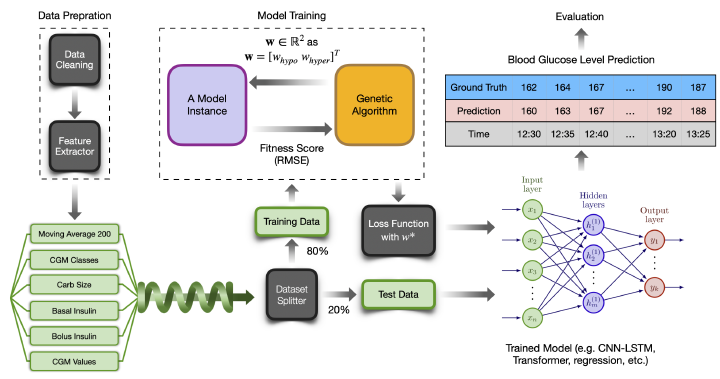
Managing Type 1 Diabetes (T1D) demands constant vigilance as individuals strive to regulate their blood glucose levels and avoid dysglycemia, including hyperglycemia and hypoglycemia. Despite advances in automated insulin delivery (AID) systems, achieving optimal glycemic control remains challenging. These systems integrate data from wearable devices such as insulin pumps and continuous glucose monitors (CGMs), helping reduce variability and improve time in range. However, they often fail to prevent dysglycemia due to limitations in prediction algorithms that cannot accurately anticipate glycemic excursions. This limitation highlights the need for more advanced glucose forecasting methods. To address this need, we introduce GLIMMER (Glucose Level Indicator Model with Modified Error Rate), a modular and architecture-agnostic training framework for glucose forecasting. GLIMMER combines structured preprocessing, a region-aware loss formulation, and genetic algorithm-based weight optimization to emphasize prediction accuracy in dysglycemic regions. We evaluate GLIMMER using two datasets: the publicly available OhioT1DM dataset and a newly collected AZT1D dataset consisting of data from 25 individuals with T1D. Our analyses demonstrate that GLIMMER consistently improves forecasting performance across baseline architectures, reducing RMSE and MAE by up to 24.6% and 29.6%, respectively. Additionally, GLIMMER achieves a recall of 98.4% and an F1-score of 86.8% for dysglycemia prediction, highlighting strong performance in clinically high-risk regions. Compared with state-of-the-art models containing millions of parameters, such as TimesNet (18.7M), BG-BERT (2.1M), and Gluformer (11.2M), GLIMMER attains comparable accuracy while using only 10K parameters, demonstrating its efficiency as a lightweight and architecture-agnostic solution for glycemic forecasting.

Saman Khamesian
Graduate Research Associate
I am a Ph.D. researcher at Arizona State University, specializing in Artificial Intelligence with a focus on health applications. As a Graduate Research Assistant in the EMIL Lab under Dr. Hassan Ghasemzadeh, I work on developing advanced machine learning solutions for Type 1 diabetes management, including personalized glucose forecasting and automated insulin delivery systems.

Asiful Arefeen
Graduate Research Assistant
I am a PhD student at Arizona State University (ASU). I am working under the supervision of Professor Hassan Ghasemzadeh at the Embedded Machine Intelligence Lab (EMIL). I am interested in explainable AI, using AI to generate interventions in digital health, machine learning, passive sensing and mobile health. I received a BS in Electrical & Electronic Engineering from Bangladesh University of Engineering & Technology (BUET) in 2019 and an MS in Biomedical Informatics from Arizona State University in 2023.
Hassan Ghasemzadeh
Director
Hassan Ghasemzadeh is a Professor of Biomedical Informatics at Arizona State University (ASU).