Multimodal examination of the acute effects of cannabis on subjective and physiological stress-related outcomes: a randomized placebo-controlled laboratory study
Abstract
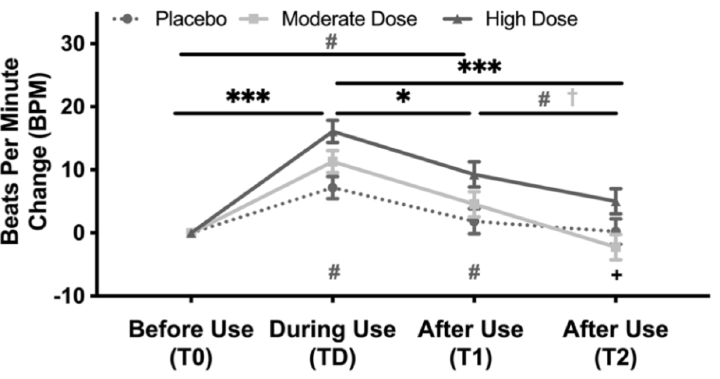
People who use cannabis commonly report stress-relieving effects, yet no studies have simultaneously assessed the acute effects of cannabis on multiple stress systems under placebo-controlled conditions. We conducted a randomized, double-blind, placebo-controlled trial in which 120 people (56 men, 52 women, 12 non-binary/transgender) who regularly use cannabis were assigned to vape placebo, a moderate dose (20 mg Δ⁹-tetrahydrocannabinol [THC]), or a high dose (40 mg THC) of cannabis. Stress ratings and salivary cortisol samples were obtained before (T0), 5 minutes (T1), and 60 minutes (T2) after vaping. Participants wore an Embrace wristband continuously measuring electrodermal activity (EDA), heart rate (HR), and heart rate variability (HRV). Stress ratings decreased across all conditions from T0 to T1 (p = 0.01) and T2 (p < 0.001), suggesting expectancy effects rather than cannabis effects. Salivary cortisol concentration decreased from T0 to T1 across all conditions (p < 0.001), with a significantly larger decrease in the high-dose condition (p = 0.03), followed by an increase from T1 to T2 in both cannabis conditions (p = 0.001). Skin conductance response amplitude and area under the curve decreased in both cannabis conditions (p’s < 0.01), whereas peaks-per-minute increased in the high-dose condition at T2 (p = 0.01). HR was elevated significantly more in the high-dose than placebo condition during vaping (p = 0.001) and at T1 (p = 0.02). No effects of cannabis on HRV were detected. These findings indicate that cannabis intoxication divergently modulates stress physiology, attenuating neuroendocrine and electrodermal responses while elevating cardiovascular arousal and producing subjective stress reductions comparable to placebo. Thus, common perceptions of stress relief do not reflect uniform suppression of stress-related outcomes. This has important implications for the widespread use of cannabis as a coping strategy.
Reza Rahimi Azghan
Grad Research Associate
I am a Ph.D. student at Arizona State University. I work as a Graduate Research Associate at Embedded Machine Intelligence Lab (EMIL) under the supervision of Dr. Hassan Ghasemzadeh.

Hassan Ghasemzadeh
Director
Hassan Ghasemzadeh is a Professor of Biomedical Informatics at Arizona State University (ASU).