Abstract
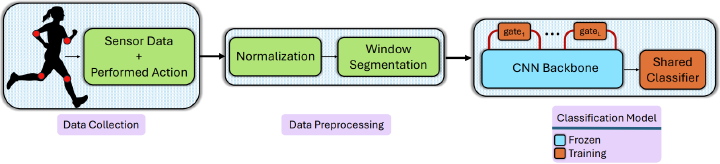
Wearable sensors in Internet of Things (IoT) ecosystems increasingly support applications such as remote health monitoring, elderly care, and smart home automation, all of which rely on robust human activity recognition (HAR). Continual learning systems must balance plasticity (the ability to learn new tasks) with stability (the retention of previously acquired knowledge). However, AI models often exhibit catastrophic forgetting, where learning new tasks degrades performance on earlier ones. This challenge is particularly acute in domain-incremental settings such as HAR, where on-device models must adapt to new subjects with distinct movement characteristics while maintaining accuracy on previously seen subjects without transmitting sensitive data to the cloud. In this work, we propose a parameter-efficient continual learning framework based on channel-wise gated modulation applied to frozen pretrained representations. Our key insight is that adaptation should operate through feature emph{selection} rather than feature emph{generation}: by restricting learned transformations to diagonal scaling of existing features, we preserve the geometric structure of pretrained representations while enabling subject-specific modulation. We provide a theoretical analysis showing that gating implements a bounded diagonal operator that limits representational drift compared to unconstrained linear transformations. Empirically, we demonstrate that freezing the backbone substantially reduces forgetting and that lightweight gates restore the adaptation capacity lost from freezing, achieving both stability and plasticity simultaneously. On the PAMAP2 dataset with 8 sequential subjects, our approach reduces forgetting from 39.7% (trainable backbone) to 16.2% and improves final accuracy from 56.7% to 77.7%, while training less than 2% of model parameters. Our method matches or exceeds standard continual learning baselines without requiring replay buffers or task-specific regularization, confirming that structured diagonal operators provide an effective and efficient mechanism for continual learning under distribution shift.
Reza Rahimi Azghan
Grad Research Associate
I am a Ph.D. student at Arizona State University. I work as a Graduate Research Associate at Embedded Machine Intelligence Lab (EMIL) under the supervision of Dr. Hassan Ghasemzadeh.

Hassan Ghasemzadeh
Director
Hassan Ghasemzadeh is a Professor of Biomedical Informatics at Arizona State University (ASU).