GluBox: Glucose Prediction for Type 1 Diabetes from Multimodal Wearable Sensors using Region-Sensitive Loss and Bayesian Optimization
Abstract
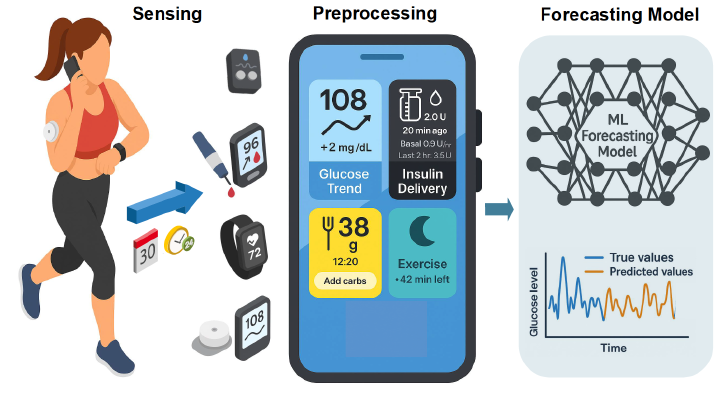
Integrating Artificial Intelligence (AI) into wearable sensor systems for disease prevention and management, such as type 1 diabetes, necessitates the development of forecasting models capable of learning from heterogeneous multimodal data while operating under realistic computational and deployment constraints. A particular growing area of research in this domain is the development of machine learning models that forecast blood glucose levels using wearable sensor data. Such models must effectively map the complex interactions between physiological signals and lifestyle variables to future blood glucose levels. However, existing blood glucose forecasting methods achieve only moderate performance levels on wearable sensing data, limiting their practical effectiveness. To address this challenge, we present GluBox, a multimodal forecasting system that leverages continuous glucose monitoring (CGM) as a core wearable sensing modality, together with behavioral and clinical data that influence blood glucose patterns, to predict long-term blood glucose patterns in individuals with type 1 diabetes while prioritizing clinically consequential errors. GluBox devises a custom weighted loss function that asymmetrically penalizes prediction errors associated with hypoglycemic and hyperglycemic events, explicitly aligning training objectives of the machine learning model with clinical risks of experiencing abnormal blood glucose outcomes. To efficiently tune these loss-weight parameters without exhaustive evaluation of all candidate configurations, we leverage Bayesian optimization, reducing the number of computationally expensive training iterations required to identify clinically effective operating points. We evaluate GluBox on two large-scale datasets comprising over 38,000 hours of data from 34 patients with type 1 diabetes. Results indicate that GluBox outperforms state-of-the-art glucose forecasting models, achieving an RMSE reduction of approximately 14-15%, with pronounced improvements in clinically critical glycemic ranges.

Pegah Khorasani
Graduate Research Associate
As a doctoral candidate at Arizona State University (ASU), I am currently conducting research under the guidance of Professor Hassan Ghasemzadeh at the Embedded Machine Intelligence Lab (EMIL). My research interests encompass a range of topics, including machine learning, health monitoring system development, and mobile health.


Abdullah Mamun
Graduate Research Associate
I am a Ph.D. student at Arizona State University. I work as a Graduate Research Associate at Embedded Machine Intelligence Lab (EMIL) under the supervision of Dr. Hassan Ghasemzadeh.
Hassan Ghasemzadeh
Director
Hassan Ghasemzadeh is a Professor of Biomedical Informatics at Arizona State University (ASU).