Comparable physiological stress responses following music listening and quiet reading: An exploratory pilot study
Abstract
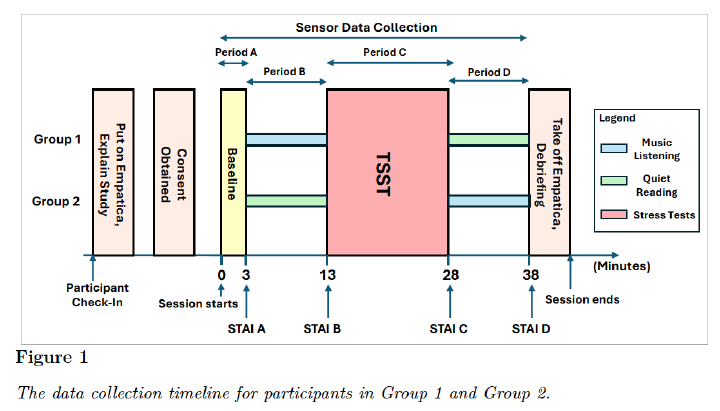
Music listening is a common stress management strategy, but its potential to protect individuals from upcoming stress remains underexplored. This pilot study examined whether music heard before a stressful event alters physiological and psychological responses. Thirty participants were randomly assigned to either listen to 10 minutes of self-selected relaxing music or engage in an active control of quiet reading prior to a modified Trier Social Stress Test. Electrodermal activity (EDA) and heart rate variability (HRV) were recorded with a wearable wristband. Thirteen features were extracted from these signals across three phases (baseline, pre-stress, stress) and analyzed using mixed-ANCOVA, controlling for trait anxiety and baseline values. Both groups showed similar reductions in self-reported anxiety during the pre-stress period, suggesting that any pleasant, absorbing activity may mitigate anticipatory anxiety. However, physiological outcomes revealed divergent patterns: the music group exhibited a smaller increase in tonic EDA during the stressor, consistent with buffered sympathetic arousal, whereas the control group showed a larger increase from the pre-stress to stress period in parasympathetic HRV indices pNN50 and NN50 (the percentage and count of consecutive beats differing by more than 50ms, respectively). These findings suggest that both self-selected music and quiet reading before a stressor may support adaptive stress responding, but with partly distinct autonomic patterns, rather than a clear overall advantage of one activity. Given the small sample size, the results should be considered preliminary and point to the need for further research on how self-selected music can be used to prevent or lessen stress responses.

Nooshin Taheri Chatrudi
Graduate Teaching Assistant
I am a Ph.D. student at the College of Health Solutions, Arizona State University (ASU). Currently, I am working under the supervision of Dr. Hassan Ghasemzadeh at the Embedded Machine Intelligence Lab (EMIL). My research interests include machine learning, clinical informatics, and health monitoring system development.

Abdullah Mamun
Graduate Research Associate
I am a Ph.D. student at Arizona State University. I work as a Graduate Research Associate at Embedded Machine Intelligence Lab (EMIL) under the supervision of Dr. Hassan Ghasemzadeh.
Hassan Ghasemzadeh
Director
Hassan Ghasemzadeh is a Professor of Biomedical Informatics at Arizona State University (ASU).