Use of What-if Scenarios to Help Explain Artificial Intelligence Models for Neonatal Health
Abstract
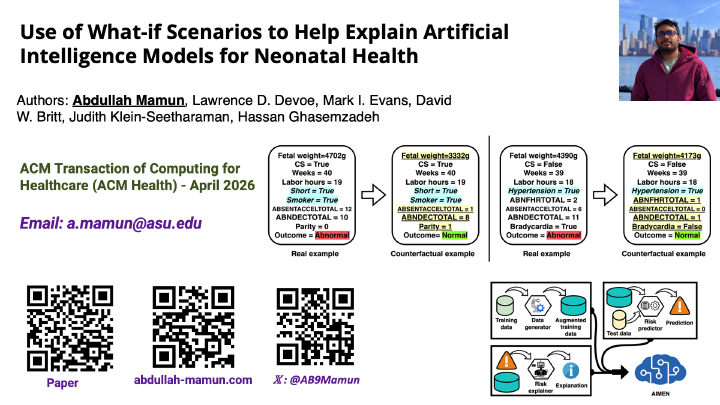
Early detection of intrapartum risks enables timely interventions to prevent or mitigate adverse labor outcomes such as cerebral palsy. However, accurate automated systems to support clinical decision-making during delivery are currently lacking. To address this gap, we propose Artificial Intelligence for Modeling and Explaining Neonatal Health (AIMEN), a deep learning framework that predicts adverse labor outcomes from maternal, fetal, obstetrical, and intrapartum factors while providing interpretable reasoning behind its predictions. AIMEN reveals how specific modifications to input variables could alter predicted outcomes, enhancing clinical insight. To address class imbalance and limited sample size, AIMEN employs Conditional Tabular GAN (CTGAN) for data augmentation. This process includes synthetic data generation, and we investigate in detail properties such as relaxing feature bounds for a subset of training points to explore slightly out-of-range physiological values, and applying silhouette-score-based filtering to increase the separability of synthetic samples. AIMEN uses an ensemble of fully connected neural networks for classification and outperforms state-of-the-art models such as XGBoost, TabNet, DANet, and LightGBM, achieving an average F1 score of 0.784 in predicting high-risk deliveries. Moreover, AIMEN generates counterfactual explanations that identify actionable changes involving only two to three attributes on average. Resources: https://github.com/ab9mamun/AIMEN.

Abdullah Mamun
Graduate Research Associate
I am a Ph.D. student at Arizona State University. I work as a Graduate Research Associate at Embedded Machine Intelligence Lab (EMIL) under the supervision of Dr. Hassan Ghasemzadeh.

Hassan Ghasemzadeh
Director
Hassan Ghasemzadeh is a Professor of Biomedical Informatics at Arizona State University (ASU).