Abstract
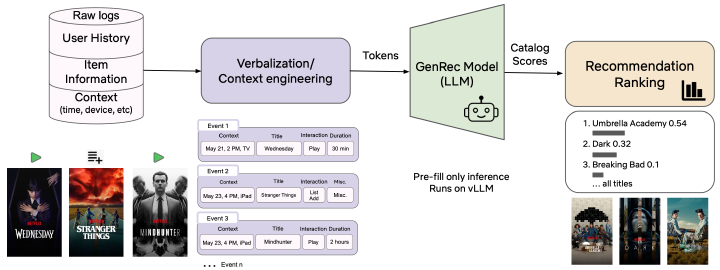
Large language models (LLMs) are reshaping recommender systems by enabling richer modeling of users, content, and context directly in natural language. At Netflix, we are exploring this direction through GenRec, an LLM-backed recommendation ranker built on top of an in-house foundational LLM. GenRec follows a two-phase framework: Phase 1 adapts an open-source LLM to Netflix data, developing deep understanding of the catalog and member behavior while balancing capabilities such as content understanding and instruction following. Phase 2 post-trains this foundation model with recommendation-ranking specific data, labels, and reward signals, aiming to align the ranker with business requirements and long-term member satisfaction. This paper focuses on Phase 2 and the transition from a traditional discriminative ranker with thousands of engineered features to an LLM-backed ranker driven by verbalized user histories and context. We describe our design for input verbalization and context engineering, post-training data construction, reward integration, model architecture, and a cost-constrained serving design based on prefill-only inference approach. We report results from a large-scale A/B test in comparing GenRec against the current production ranker model, where we show that a GenRec model trained with substantially fewer Phase-2 labeled training examples and input signals can achieve statistically significant gains in offline and online metrics. We discuss how LLM-backed recommenders could shift the recommendation paradigm: from feature engineering to context engineering, and from bespoke architectures to shared foundation backbones. We also outline practical lessons for serving such systems under real-world resource constraints.

Saman Khamesian
Graduate Research Associate
I am a Ph.D. researcher at Arizona State University, specializing in Artificial Intelligence with a focus on health applications. As a Graduate Research Assistant in the EMIL Lab under Dr. Hassan Ghasemzadeh, I work on developing advanced machine learning solutions for Type 1 diabetes management, including personalized glucose forecasting and automated insulin delivery systems.