Abstract
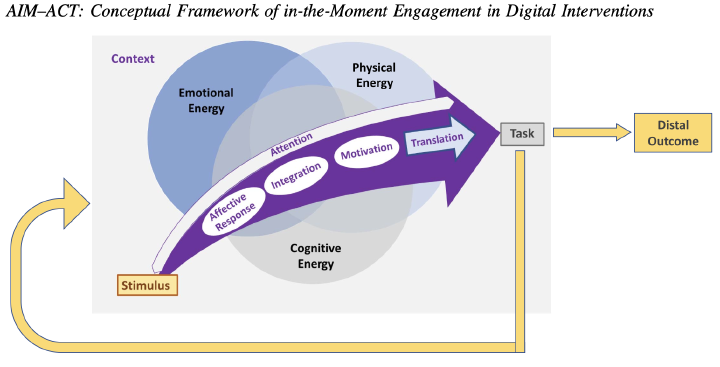
The notion of“engagement,” which plays an important role in various domains of psychology, is gaining increased currency as a concept that is critical to the success of digital interventions. However, engagement remains an ill-de ned construct, with different fields generating their own domain-specific definitions. Moreover, given that digital interactions in real-world settings are characterized by multiple demands and choice alternatives competing for an individual’s effort and attention, they involve fast and often impulsive decision-making. Prior research seeking to uncover the mechanisms underlying engagement has nonetheless focused mainly on psychological factors and social influences and neglected to account for the role of neural mechanisms that shape individual choices. This article aims to integrate theories and empirical evidence across multiple domains to define engagement and discuss opportunities and challenges to promote effective engagement in digital interventions. We also propose the affect–integration–motivation and attention–context–translation (AIM–ACT) framework, which is based on a neurophysiological account of engagement, to shed new light on how in-the-moment engagement unfolds in response to a digital stimulus. Building on this framework, we provide recommendations for designing strategies to promote engagement in digital interventions and highlight directions for future research.

Saman Khamesian
Graduate Research Associate
I am a Ph.D. researcher at Arizona State University, specializing in Artificial Intelligence with a focus on health applications. As a Graduate Research Assistant in the EMIL Lab under Dr. Hassan Ghasemzadeh, I work on developing advanced machine learning solutions for Type 1 diabetes management, including personalized glucose forecasting and automated insulin delivery systems.