Seminar: Asking AI Better Questions
Abstract
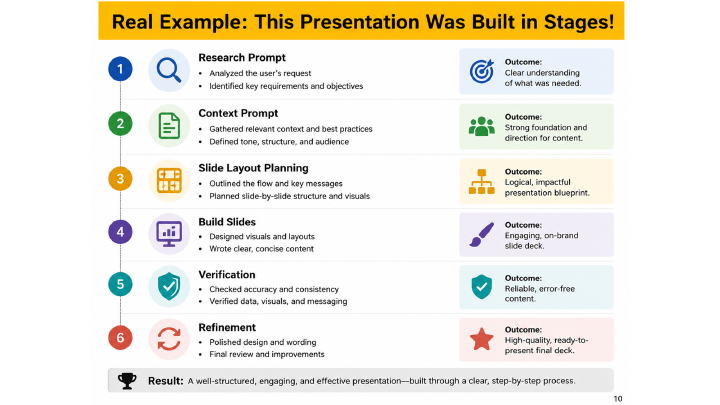
This presentation provides a practical overview of how researchers can communicate more effectively with artificial intelligence systems by treating prompting as a structured research communication skill. Although AI is increasingly used for literature summarization, writing revision, code debugging, experiment planning, and idea development, requests are often written without a repeatable method for specifying what the system should do. The presentation explains how missing information about the task, context, constraints, expected output, or verification process can lead to generic, incomplete, overly complex, or unsupported responses. To address this problem, it introduces a practical five-component checklist consisting of task, context, constraints, output, and verification. This checklist represents a synthesis of recurring recommendations in guidance from OpenAI, Anthropic, and Google rather than a formal or official prompting framework. Weak-and-strong prompt comparisons demonstrate how the checklist can clarify the purpose, scope, audience, format, and evidentiary requirements of a request. The framework is then applied to common research activities, including analyzing papers for literature reviews, revising scientific writing without changing its meaning, and designing coding or experimental workflows before implementation. The presentation also demonstrates how complex AI-assisted projects can be divided into research, contextualization, planning, drafting, verification, and refinement stages. It concludes by emphasizing that stronger prompts can improve the relevance and usability of AI outputs, but they cannot guarantee correctness or replace the researcher’s responsibility to evaluate sources, assumptions, evidence, scope, and practical usefulness.