Uncertainty-Aware Prediction and Bedtime Smart Snack Intervention for Preventing Nocturnal Hypoglycemia in Type 1 Diabetes
Abstract
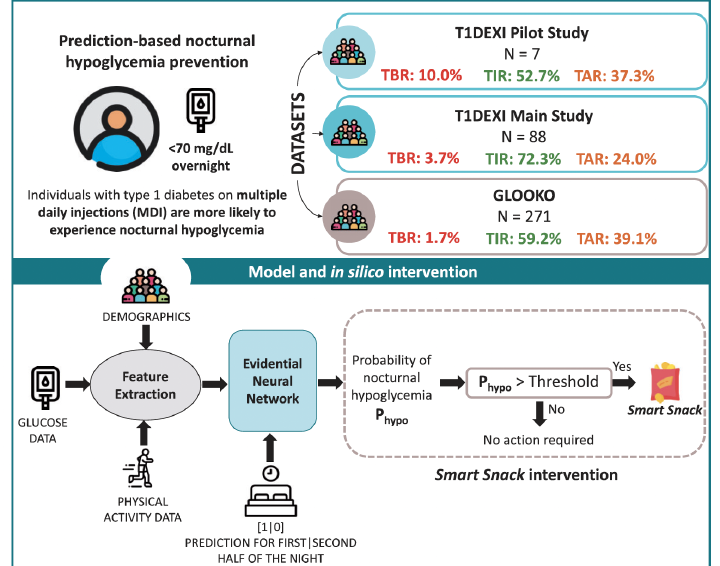
Nocturnal hypoglycemia remains a major challenge for people with type 1 diabetes (T1D), particularly among individuals using multiple daily insulin injections and engaging in late-day physical activity. This study proposes a unified prediction-and-prevention framework that combines uncertainty-aware modeling with a proactive bedtime intervention. An evidential neural network (ENN) was developed to predict, at bedtime, the probability and timing of nocturnal hypoglycemia during the first (0–4 h) and second (4–8 h) halves of the night, while also quantifying predictive uncertainty. Predictions were integrated into a Smart Snack algorithm that recommends personalized bedtime carbohydrate intake based on predicted minimum nocturnal glucose and event timing. The model was trained and evaluated using free-living continuous glucose monitoring, physical activity, and demographic data from the T1DEXI study and Glooko datasets. The ENN achieved area under the receiver operating characteristic curves of 0.80 and 0.71 for predicting hypoglycemia in the first and second halves of the night, respectively, outperforming baseline methods. In silico evaluation demonstrated that the Smart Snack intervention substantially reduced both the probability and duration of nocturnal hypoglycemia. These results suggest that uncertainty-aware prediction coupled with personalized bedtime recommendations may offer an effective decision support approach for reducing nocturnal hypoglycemia burden in T1D.
Pegah Khorasani
Graduate Research Associate
As a doctoral candidate at Arizona State University (ASU), I am currently conducting research under the guidance of Professor Hassan Ghasemzadeh at the Embedded Machine Intelligence Lab (EMIL). My research interests encompass a range of topics, including machine learning, health monitoring system development, and mobile health.